


Northern Japan braces for potential larger earthquake following tsunami-triggering quake that injured dozens and forced mass evacuations
A magnitude 7.5 earthquake struck off Japan’s northeastern coast late Monday night, prompting tsunami warnings, mass evacuations, and triggering the country’s first megaquake advisory for the region since the warning system was introduced in 2022.
The powerful tremor hit at 11:15 pm local time on December 8, with its epicentre located approximately 80 kilometres off the coast of Aomori Prefecture at a depth of 50 kilometres. The quake registered as an “upper 6” on Japan’s seven-point seismic intensity scale—strong enough to make it impossible to stand or move without crawling.
Residents across Tokyo, more than 400 kilometres from the epicentre, felt strong tremors lasting over 30 seconds, while coastal communities in the north faced immediate tsunami threats.
Tsunami Warnings and Coastal Response
The Japan Meteorological Agency initially warned that tsunamis as high as three metres could strike the northeastern coast, issuing evacuation orders for approximately 90,000 residents across Hokkaido, Aomori, and Iwate prefectures.
Tsunami waves reaching up to 70 centimetres were observed in Kuji, with waves of 50 centimetres recorded in Urakawa and 40 centimetres in Mutsu and Hachinohe. The warnings were downgraded to advisories in the early hours of Tuesday morning and fully lifted by 6:30 am local time.
Prime Minister Sanae Takaichi urged swift action from residents in affected areas. “Where a tsunami warning has been issued, please evacuate immediately to safe locations, such as high ground or evacuation buildings,” she said in a social media post.
More than 620 residents and 270 vehicles sought shelter at Japan Self-Defense Force facilities in Hachinohe, while approximately 200 passengers were stranded overnight at New Chitose Airport in Hokkaido after the domestic terminal ceiling partially cracked and collapsed.
Casualties and Damage Assessment
At least 51 people sustained injuries, including 36 in Aomori, 11 in Hokkaido, and four in Iwate, though most injuries were classified as mild. Twelve people were injured in Hachinohe alone, where a restaurant was damaged and windows shattered throughout the city.
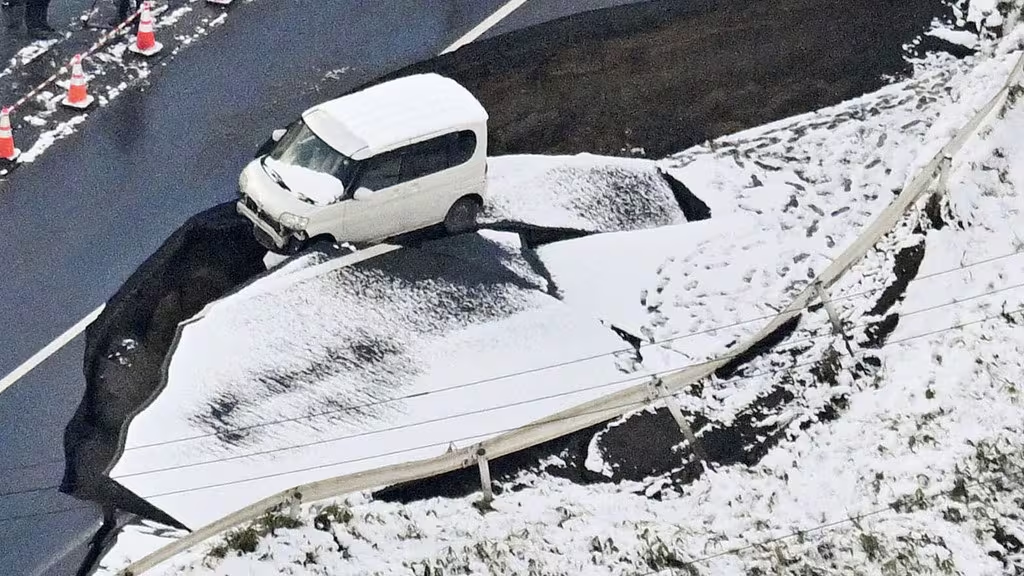
Infrastructure damage included collapsed and buckled roads in Tohoku town, flooded hospital facilities after sprinkler systems malfunctioned, and damage to approximately 1,360 homes that lost water due to broken pipes. Several oyster rafts were also damaged by tsunami waves. Classes were suspended at 187 schools across Aomori and Hokkaido.
Critically, no abnormalities were reported at the Higashidōri and Onagawa nuclear power plants, and utilities confirmed no irregularities at other nuclear facilities in the region. This was a particular relief given the area’s proximity to Fukushima, site of the 2011 nuclear disaster.
Unprecedented Megaquake Advisory
In a significant development, the Japan Meteorological Agency issued its first-ever “Hokkaido/Sanriku Offshore Earthquake Warning” on Tuesday, advising of heightened risks for a subsequent, potentially more powerful earthquake within the next week.
Officials emphasised that the advisory is not a prediction, with the probability of a magnitude 8 or larger quake estimated at only about one percent, but expressed hope it would serve as a wake-up call for improved preparedness.
The advisory applies to 182 municipalities stretching from Hokkaido in the north to Chiba Prefecture, east of Tokyo. Authorities are urging residents, particularly in coastal areas, to review emergency preparedness plans and ensure they can quickly access emergency supplies.
The warning system was introduced in December 2022, learning from patterns observed before the devastating 2011 Tōhoku earthquake, which was preceded by a magnitude 7.2 foreshock two days earlier.
Historical Context and Future Risks
The northeastern region has experienced repeated seismic trauma. On March 11, 2011, a magnitude 9.0 earthquake struck beneath the ocean off Sendai’s coast, triggering tsunamis that reached heights exceeding 15 metres in some areas and killed nearly 20,000 people. The tsunami destroyed the Fukushima Daiichi nuclear power plant, causing meltdowns that released radioactive contamination and created fears that persist today.
Japan sits on the Pacific Ring of Fire, where the Pacific Plate subducts beneath the Okhotsk microplate at a rate of 7.9 to 9.2 centimetres per year. This convergent boundary has been the site of numerous powerful historical earthquakes, dating back to the 869 Sanriku earthquake.
Government estimates suggest that a future megaquake in the Hokkaido-Sanriku area could generate tsunamis up to 30 metres high, potentially killing as many as 199,000 people, destroying up to 220,000 buildings, and causing economic damages approaching $198 billion.
The advisory will remain in effect until December 16, during which time authorities have mobilised 18 Self-Defense Force helicopters for ongoing damage assessment and response operations.
Balancing Vigilance and Normalcy
This advisory marks a more measured approach compared to last August’s “Nankai Trough” megaquake warning issued for southern Japan, which led to panic buying, event cancellations, and widespread business closures despite the low statistical probability.
Officials are walking a careful line—maintaining public vigilance while avoiding the disruption that accompanied previous warnings. The message is clear: preparation, not panic, is the appropriate response to living in one of the world’s most seismically active regions.
Japan records more than 100,000 earthquakes annually, with nearly 2,000 earthquakes of magnitude 4 or higher striking within 300 kilometres of Hokkaido in the past decade alone. For residents and visitors alike, earthquake preparedness remains an essential part of daily life.