


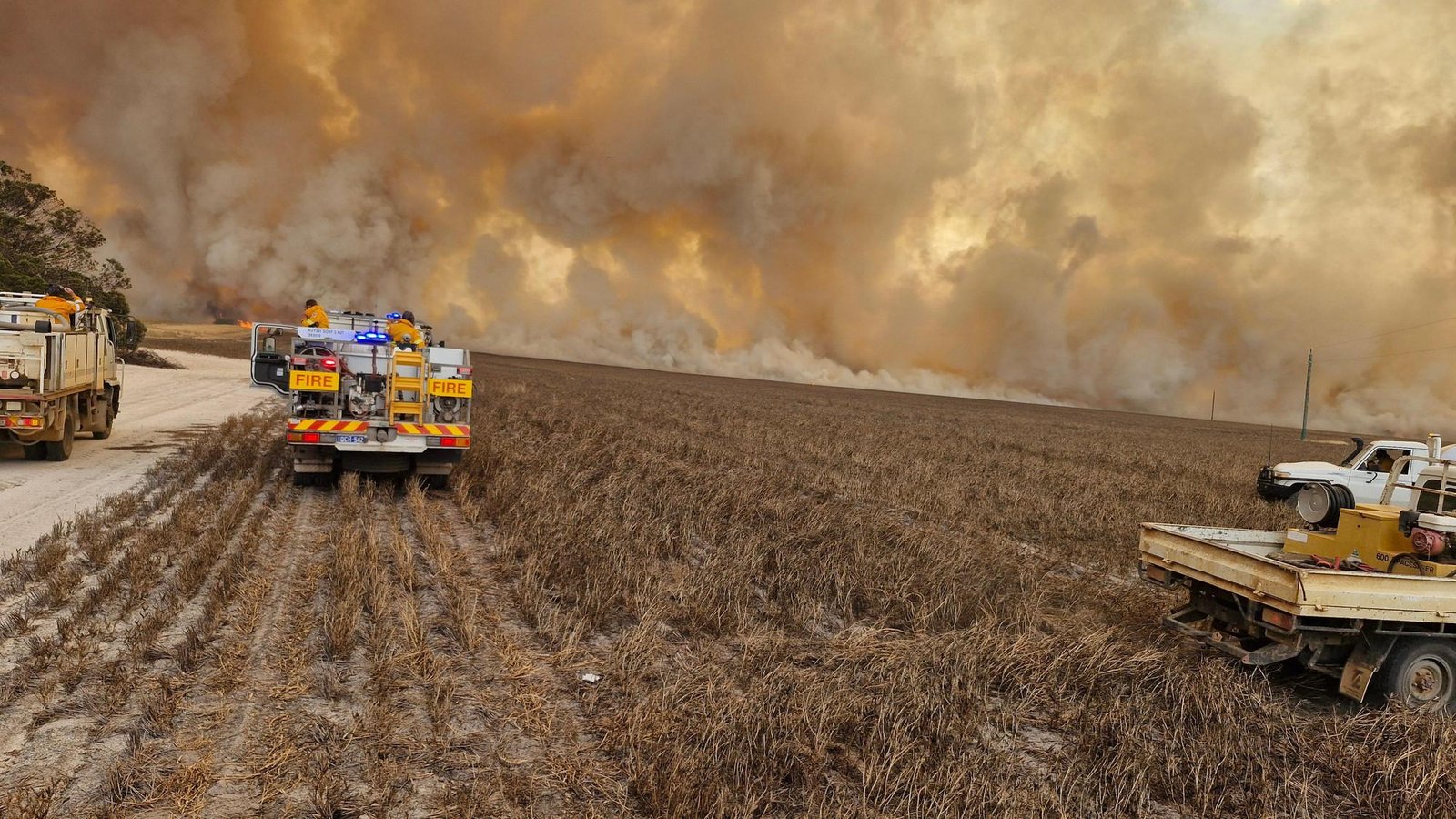
“Too late to leave” warnings issued in Great Southern region as Emergency WA website crashes during peak crisis, leaving residents scrambling for vital safety information
Western Australia faced one of its most challenging bushfire emergencies in recent memory on Monday, with five separate blazes reaching emergency warning level simultaneously while the state’s critical Emergency WA website and app crashed for more than two hours, leaving thousands of residents unable to access potentially life-saving information.
The Department of Fire and Emergency Services issued a stark acknowledgment on social media as fires raged across the state: “The Emergency WA website and app are currently experiencing technical difficulties,” directing desperate residents to ABC local radio or the information line 13 3337 while crews worked to restore the system.
The technical failure came at the worst possible moment, as emergency-level bushfires stretched from Warradarge in the Mid West to Nambeelup south of Perth, with additional warnings for Mindarra north of Perth, Bindoon and Gidgegannup. The website blackout prevented the dissemination of current bushfire warnings, road closure information and critical incident updates for more than two hours during the height of the emergency.
Great Southern Fire Escalates to “Too Late to Leave”
The most dire situation developed on Tuesday afternoon in the Great Southern region, where residents near Ongerup were issued the most severe warning possible: it is too late to leave. The Department of Fire and Emergency Services warned that the out-of-control bushfire had blocked evacuation routes and posed an immediate threat to lives and homes.
Three separate emergency level warnings were issued for the Shire of Gnowangerup fire, which began moving rapidly northeast due to strong winds on Tuesday afternoon. The most critical warning applied to residents in parts of Mindarabin bounded by Ongerup Creek, Gnowangerup-Jerramungup Road and Old Ongerup Road, where authorities confirmed that evacuatio n routes had been cut off by flames.
“You are in danger and need to act immediately to survive,” DFES stated in the emergency warning. “It is too late to leave. You need to take shelter before the fire arrives. Close all doors and windows and turn off evaporative air conditioners.”
Additional emergency “leave now” warnings were issued for surrounding areas including Jackitup, Cowalellup, Mills Lake and the Ongerup townsite itself, with residents urged to evacuate in an easterly direction towards Pingrup if it remained safe to do so. Two water bombers and an air attack supervisor plane were deployed to the scene, though DFES could not immediately confirm how the fire started.
Severe Weather Compounds Fire Danger
The Bureau of Meteorology issued a severe thunderstorm warning for the Central West, Central Wheatbelt and Great Southern districts, with senior meteorologist Jess Lingard reporting that thunderstorms were producing damaging wind gusts across multiple regions. Wind gusts of up to 102 kilometres per hour were recorded in Gnowangerup at 3pm on Tuesday, dramatically escalating fire behaviour and complicating firefighting efforts.
The thunderstorms brought a paradoxical mix of extreme conditions—lightning capable of igniting new fires, damaging winds that accelerated existing blazes, yet also the potential for rainfall that could ease the dangerous situation. Areas including Dalwallinu, Dowerin, Wongan Hills, Beacon, Cunderdin and Kellerberin experienced the severe conditions throughout Tuesday afternoon.
Road closures were implemented across the fire-affected region, including Chesterpass Road between Nyabing-Pingrup Road and Magitup Road, and Gnowangerup-Jerramungup Road between South Coast Highway and Maileeup Road. Authorities urged residents to avoid all affected areas as firefighting operations continued.
Multiple Emergency Fires Stretch Resources
The crisis unfolded across a broad geographic area, with emergency warnings active for communities hundreds of kilometres apart. In the Mid West region, approximately 250 firefighters battled two separate emergency fires near Warradarge and Mogumber, while additional fires burned at watch and act level.
South of Perth, residents in Nambeelup—located approximately 16 kilometres east of Mandurah—received urgent evacuation orders, with an evacuation centre established at the Murray Aquatic and Leisure Centre. Further north, emergency warnings were declared for parts of Chittering and Bindoon, less than 70 kilometres from Perth’s northern suburbs, as crews worked to establish containment lines.
The simultaneous nature of the emergencies placed extraordinary pressure on firefighting resources, with career firefighters and volunteer brigades deployed across hundreds of kilometres of fire front. Water-bombing aircraft were constantly redeployed between fires as priorities shifted throughout the day based on changing wind conditions and fire behaviour.
Power Outages Compound Communications Crisis
Adding to the chaos, since Saturday night storms had unleashed widespread power outages affecting up to 115,000 properties across the Perth metropolitan area, the Midwest and Wheatbelt regions. As of 4pm Monday, Western Power reported that approximately 15,000 properties remained without power, with utility crews addressing 52 hazards across their network.
Local emergency responders highlighted that telecommunications infrastructure had also been impacted by the storms and fires, severely complicating communication efforts during the emergency. The combination of website failures, power outages and damaged telecommunications meant that some communities had extremely limited access to critical emergency information.
The power disruptions created particular challenges for residents trying to access online emergency alerts or charge mobile devices to receive updates. Emergency services emphasised the importance of battery-powered radios and maintaining contact with neighbours during such emergencies.
Meteorological Factors Behind the Crisis
Senior meteorologist Jess Lingard explained that a west coast trough was driving the hot fire conditions across the state, though she noted that the system was expected to shift eastward overnight, bringing milder conditions the following day. However, the immediate danger remained extreme, with hot, dry and windy conditions continuing to elevate fire danger throughout Monday and Tuesday.
The Bureau of Meteorology had issued an extreme fire danger warning for the areas of Barrup and Blackwood, with conditions creating an ideal environment for rapid fire spread. Lightning and wind from thunderstorms in the South West Land Division had the dual effect of potentially igniting new fires while simultaneously spreading existing blazes.
Heatwave warnings were also active for much of Western Australia during the period, contributing to the dangerous fire weather conditions. The combination of elevated temperatures, low humidity, strong winds and accumulated fuel loads from winter rainfall created what fire authorities described as a perfect storm for catastrophic fire behaviour.
Historical Context and Seasonal Outlook
Western Australia’s fire season has been particularly active during the 2024-25 summer, with the Australasian Fire and Emergency Service Authorities Council identifying western and southern WA as key regions at risk of heightened bushfire activity. Parts of the state have experienced severe soil moisture and rainfall deficiencies, while high fuel loads combined with hot and dry weather have driven elevated fire danger.
The pattern follows healthy wet season rainfall during the cooler months, which allowed fuel loads to grow substantially. The subsequent hot and drying trend over summer has allowed these fuels to cure rapidly, increasing the risk of significant fires, especially during mid-to-late summer.
The current fire crisis occurs against a backdrop of multiple recent significant fire events across WA, including the 2021 Wooroloo bushfire that destroyed more than 30 homes and burned approximately 7,000 hectares across northern parts of the Perth Hills. That event highlighted the vulnerability of interface communities between urban development and bushland, a pattern being repeated in the current emergency.
System Failures Raise Critical Questions
The failure of the Emergency WA website and app during the height of the emergency has sparked serious concerns about communication resilience during disasters. The platform is designed as the state’s official source for community warnings and emergency management information for bushfires, storms, cyclones, floods and other hazards.
While DFES was able to redirect residents to alternative information sources including ABC local radio and the 13 3337 information line, the two-hour outage demonstrated the vulnerability of digital alert systems when they are needed most. The incident has raised questions about backup systems, server capacity during high-demand emergencies, and redundancy planning.
Emergency management experts note that while traditional methods like radio broadcasts remain crucial during emergencies, an increasing proportion of the population relies primarily on digital sources for real-time information. The failure highlighted the need for robust, redundant systems capable of handling surges in demand during major emergencies.
Looking Ahead
As Tuesday evening approached, emergency warnings remained in place across multiple regions, with the Great Southern fire continuing to pose the most immediate threat to lives and homes. Firefighting operations were expected to continue through the night, with crews working to establish containment lines and protect threatened properties.
The Bureau of Meteorology’s forecast suggested that milder conditions would arrive as the west coast trough moved eastward, potentially providing firefighters with better conditions for containment efforts. However, authorities cautioned that fire behaviour can change rapidly and urged all residents in affected areas to remain vigilant and prepared to act on warnings.
The combination of lightning-caused ignitions, suspected arson fires, and extreme weather conditions suggests that Western Australia faces ongoing fire risk throughout the remainder of the summer season. Fire authorities continue to urge residents to have updated bushfire survival plans, maintain defendable space around properties, and stay informed through multiple information sources.
For the latest updates on fire warnings and emergencies, residents should monitor emergency.wa.gov.au when available, listen to ABC Local Radio or 6PR, call 13 DFES (13 3337), and follow DFES social media channels. In life-threatening emergencies, residents should call 000 immediately.